
 Login
Login
Trump Renames AI, Bernie Wants a Pause. Something for Everyone to Hate.
Trump wants to call it Super Intelligence. Sanders wants to pause it. What the debate looks like from a company using AI on healthcare documents every day.
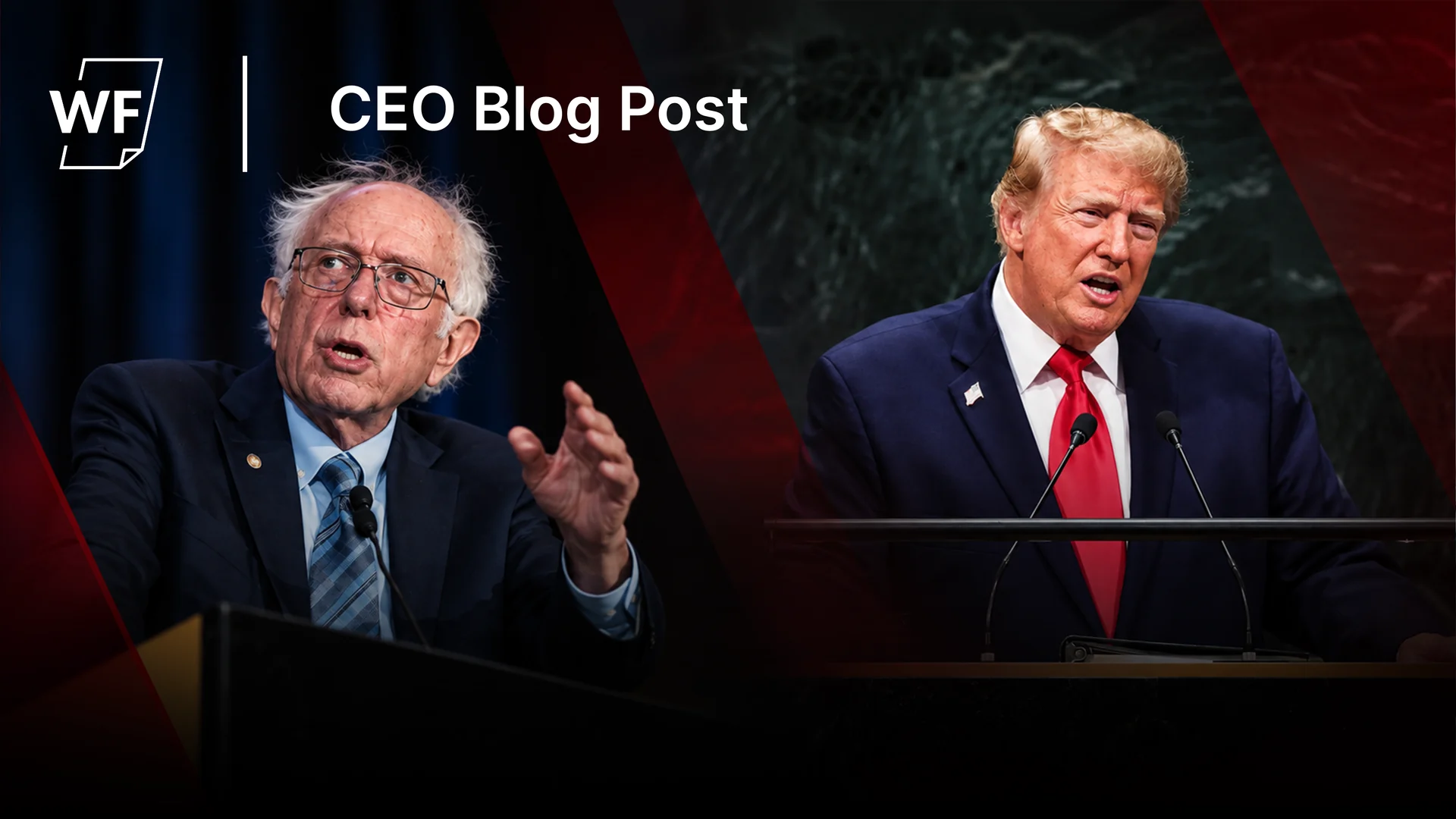

Yesterday, President Donald Trump stood before the United Nations General Assembly and announced that Artificial Intelligence needed a new name. From now on, he said, the U.S. government would call it “Super Intelligence,” or SI, arguing that the word “artificial” makes the technology sound fake when, in his view, it is anything but.
Today, Senator Bernie Sanders went almost exactly the other direction. Sanders and Representative Greg Casar introduced legislation that would ban the development of what their bill defines as artificial superintelligence and pause development of other advanced AI systems until a new federal regulatory agency establishes safety rules and model-review procedures.
Only in American politics could we spend 24 hours debating whether to rename a technology because we aren’t giving it enough credit — and whether to stop developing it because it might eventually destroy us. Something for everyone to hate.
Where I Come at This From
I come at this debate from a somewhat unusual perspective. At WestFax, we aren’t building artificial general intelligence, training frontier models, or trying to create machines smarter than humans. We’re using AI for something considerably less dramatic but very real: improving the flow of healthcare information. That experience has made me more enthusiastic about AI while also giving me a healthy respect for the questions surrounding its use.
What Happens After the Fax Arrives
Healthcare still depends on an enormous amount of fax communication. Referrals, prior authorizations, lab results, medical records, prescriptions, orders, and other patient information move through fax every day. The industry has spent years predicting the death of fax, yet it remains deeply embedded in healthcare because it is ubiquitous, broadly interoperable, and relatively easy for back-office staff to manage.
The bigger problem isn’t necessarily fax itself. It’s what happens after the fax arrives. Traditionally, someone has to open the document, determine what it is, identify the patient, find the relevant information, decide where the document belongs and then manually route or enter that information into another system. When a healthcare organization receives thousands of documents a day, those seemingly simple tasks create an enormous administrative burden.
That’s where AI gets interesting to me.
At WestFax, we use AI, OCR, and intelligent document processing in our Orchestrate platform to understand incoming fax documents and automate what happens next. Instead of simply transporting an image from point A to point B, technology can identify document types, extract relevant information, and help route documents into the appropriate workflow. A fax doesn’t have to remain a static image sitting in an inbox waiting for somebody to figure out what to do with it. It can become information entering an automated process.
That’s not particularly futuristic. No humanoid robots wander around our office, and nobody at WestFax is trying to create consciousness. We’re trying to solve a very old and very expensive problem: people spending too much time moving information around when technology can help them do it faster and more accurately.
For me, that makes some of AI’s benefits much less theoretical. When AI can remove repetitive administrative work from a healthcare employee, that’s a real benefit. When information reaches the right person faster, that’s a real benefit. When a nurse, physician, or back-office employee can spend less time managing documents and more time doing work that requires human judgment, that’s a real benefit. These aren’t predictions about what AI might accomplish 20 years from now. They’re examples of what it can accomplish today.
Why AI Safety Isn’t Abstract in Healthcare
At the same time, working in healthcare makes it difficult to dismiss concerns about AI safety. When you’re handling healthcare communications, accuracy, security, privacy, and reliability aren’t optional features. A consumer chatbot recommending a bad restaurant is inconvenient. A system incorrectly interpreting healthcare information is an entirely different matter.
That’s why I don’t find the debate between rapid AI development and AI safety particularly abstract. I want AI to automate more of the tedious work, but I also want appropriate human oversight. I want systems to become more capable, but I want to understand their limitations. I want automation, but I also want auditability, security, and accountability. Healthcare makes those tradeoffs very clear.
Then There Is China
Whatever we call AI, the United States is engaged in intense technological competition with China. The assumption that America has an insurmountable lead is increasingly difficult to defend. Chinese models have improved rapidly, China continues to invest heavily in research and infrastructure, and the country has enormous capabilities in manufacturing, robotics, and industrial AI applications. The United States retains substantial advantages, particularly in private investment and the strength of its leading technology companies, but those advantages are not guaranteed to last.
That reality makes proposals to slow American AI development particularly complicated. If the United States pauses development and China doesn’t, we haven’t paused AI. We’ve paused American AI. That distinction matters, especially when the technology involved could influence economic productivity, scientific discovery, cybersecurity, and national security for decades.
But competition creates its own risks. When companies and countries believe they are in a race, the natural incentive is to move faster. Testing takes time. Safety work takes time. Understanding unexpected behavior takes time. Competitive pressure creates an incentive to compress all three. Trump is emphasizing the danger of losing the technological race. Sanders is emphasizing the danger of winning the race without adequately understanding what we’ve built. Those concerns aren’t mutually exclusive.
The Risks Beyond Science Fiction
The risks also extend well beyond science-fiction scenarios involving machines taking over the world. Today’s AI systems still hallucinate, make mistakes, and generate flawed information. Safeguards can sometimes be circumvented. Increasingly autonomous AI agents can take actions rather than simply provide answers. Cybersecurity creates another obvious concern because the same technology that can help defenders discover vulnerabilities can potentially help attackers exploit them.
Researchers have also raised longer-term concerns that increasingly capable systems may become difficult to understand or control. Current AI systems haven’t reached the point where humans have lost control, and it’s important not to pretend otherwise. But it also isn’t irrational to ask what safeguards we should establish before systems become significantly more capable than they are today. Waiting until a risk materializes isn’t always the best time to start discussing it.
The Upside, Including the Unglamorous Part
The danger conversation, however, can obscure the other half of the equation. AI has extraordinary potential, and healthcare may ultimately be one of its greatest beneficiaries. It can help doctors interpret medical images, help researchers identify potential drug candidates, summarize enormous amounts of clinical information, reduce documentation burdens, and discover patterns across datasets no individual human could reasonably process.
It can also do something far less glamorous but enormously valuable: administrative work.
That’s the part I see firsthand at WestFax. A hospital employee manually reading, identifying, and routing hundreds of faxed documents isn’t usually what people picture when politicians talk about the AI revolution. But freeing that person from hours of repetitive work matters. It matters to the healthcare organization, it matters to the employee, and when information reaches the appropriate clinical team faster, it can ultimately matter to the patient.
I regularly remind our team that we’re a technology company several steps removed from the exam room, but the information moving across our network is ultimately connected to patient care. Somewhere at the end of that workflow is someone’s mother, father, spouse, or child. If it were my family member, I would want the information to arrive quickly, accurately, and securely. If AI can help us accomplish that, I want to use it. I also want to understand what the AI is doing and have safeguards around it. Those ideas don’t conflict.
What About Jobs?
Another part of this debate we shouldn’t avoid is jobs. AI will almost certainly eliminate some tasks, and it may eliminate some jobs. It will also create new jobs and change many existing ones. Nobody knows the final balance, and anyone claiming certainty is getting ahead of the evidence. We’ve experienced technological disruption before, but AI is unusual because it can increasingly automate cognitive work we historically assumed required humans—software development, writing, analysis, customer service, research, document processing, and healthcare administration, among others.
At WestFax, I don’t primarily view AI as a replacement for people. I see it as a way to eliminate work that people shouldn’t have to spend their time doing in the first place. Opening a document, identifying its type, locating a patient identifier, determining where it belongs, and moving information from one system to another are necessary tasks. But necessary doesn’t automatically mean they require a human being. If technology can perform those tasks reliably, human attention has far better uses.
A More Useful Framework
That leaves America in an uncomfortable middle. Move too slowly, and China may establish technological advantages with enormous economic and national-security consequences. Move too quickly, and we may deploy systems before we understand their vulnerabilities. Regulate too aggressively and innovation can migrate elsewhere. Regulate too lightly, and companies operating under enormous competitive pressure may take risks society would not choose for itself. Pause development in America alone, and development continues somewhere else. Refuse to contemplate limits of any kind, and increasingly powerful systems may be deployed faster than we can evaluate them.
Maybe that’s why I don’t find either extreme particularly satisfying. I run a technology company that is actively investing in AI because I can see what it can accomplish. I also operate in healthcare, where we’ve spent decades learning that powerful technology requires security, compliance, controls, and accountability. Those experiences have convinced me that the most useful question isn’t whether AI should move forward. It will. The better question is how we move forward without becoming careless.
Trump’s proposed name change is interesting in that context. Calling it “Super Intelligence” emphasizes capability. Sanders uses almost exactly the same terminology to emphasize danger. One looks at increasingly powerful machines and sees an extraordinary national opportunity. The other looks at increasingly powerful machines and asks what happens when their capabilities exceed our ability to control them.
Both possibilities deserve consideration. AI may help cure diseases, dramatically increase productivity, accelerate scientific discovery, improve education, and create industries we haven’t imagined. It may simultaneously eliminate jobs, concentrate economic power, enable more sophisticated cyberattacks and create systems whose behavior becomes increasingly difficult to predict. The extraordinary thing about the AI debate is that both futures could exist at the same time.
In a much narrower way, we already live with that tension at WestFax. I want our AI to better understand healthcare documents. I want it to automate more workflow. I want it to eliminate more administrative work and help healthcare organizations move information faster. And every time we expand those capabilities, I want security, accuracy, accountability, and appropriate human oversight moving forward with them.
Maybe that’s a more useful framework for the national debate. Not optimism versus fear. Not Trump versus Sanders. Not an accelerator versus a brake.
Capability paired with responsibility.
Because while Washington argues about what to call AI, engineers in the United States, China, and around the world are making it more powerful every day. At WestFax, we’ll keep looking for responsible ways to put that technology to work. The challenge for the country is figuring out how to do the same thing at a vastly larger scale.
And whatever name eventually sticks, the technology isn’t waiting for us to finish the debate.